
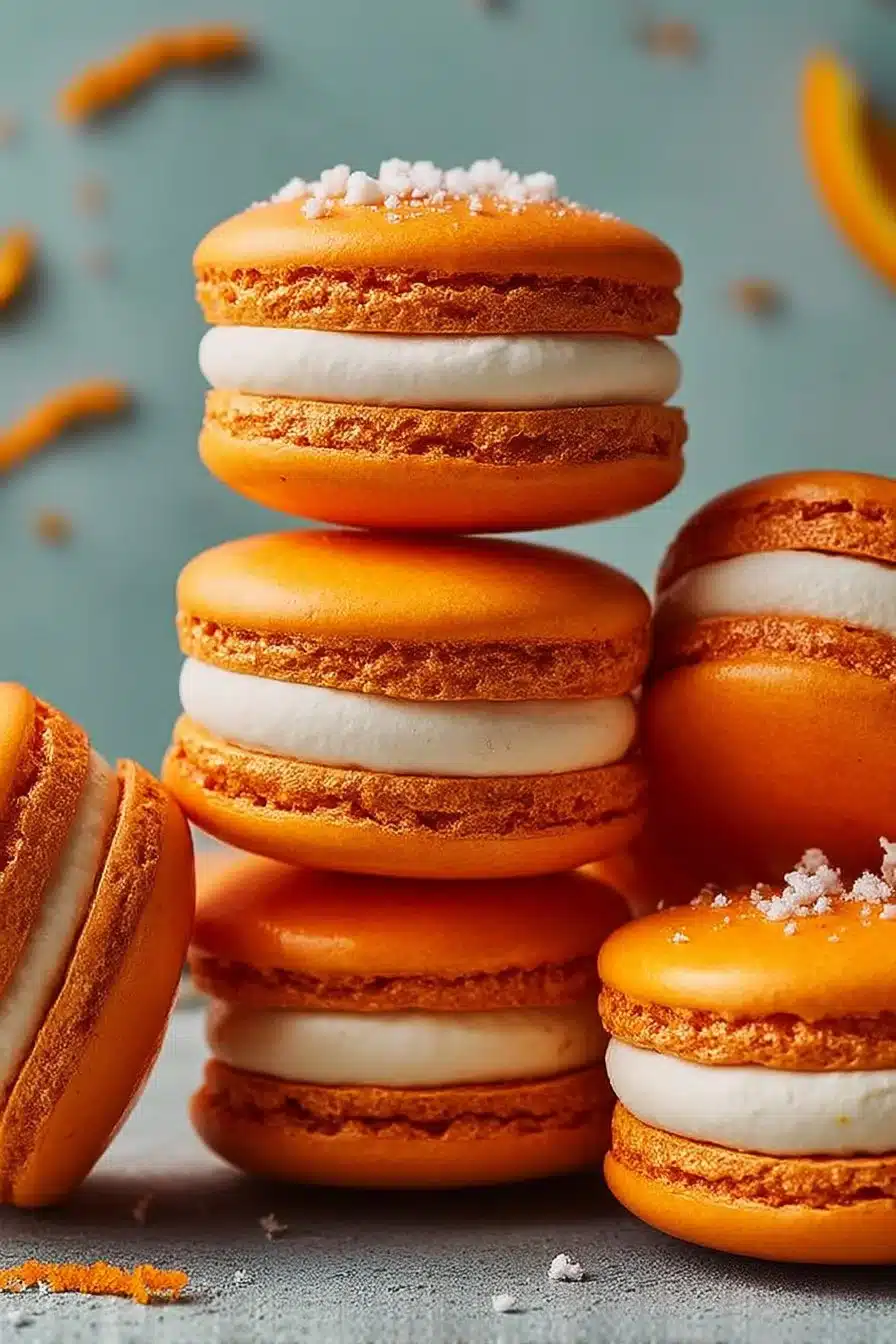
Orange Creamsicle macarons are a bright, citrusy riff on the classic French cookie—airy almond shells with a velvety orange–cream filling. The shells bake up pale and glossy with the telltale “feet,” while the cream cheese–butter filling tastes like a creamsicle: zesty orange, soft dairy tang, and a light, melt-in-your-mouth finish.
They’re worth the effort when you want a small-but-impressive dessert: delicate, portable, and pleasantly balanced between sweet and tangy. If you like citrus desserts, try making them alongside a rich, chilled option like a no-bake orange creamsicle cheesecake for a contrasting texture on the dessert table.
Why You’ll Love This Recipe
- Bright orange flavor from fresh zest (not just extract) folded into the filling delivers real citrus aroma rather than a one-note candy sweetness.
- Macaron shells are smooth and glossy with clean feet when you hit the right “lava” batter texture—soft but flowing enough to pipe neat 1‑inch rounds.
- The cream cheese–butter filling gives a silky, slightly tangy contrast that keeps the sandwich from tasting cloying.
- Make-ahead advantage: chilling the assembled macarons for 12–24 hours deepens the orange flavor and softens the shells for an ideal tender bite—handy for entertaining.
- If you enjoy citrus macarons, you can compare techniques and flavor ideas with other citrus macaron versions like mandarin orange macarons to tweak your flavor intensity.
The Story Behind This Recipe
I dialed the filling toward fresh orange zest and a touch of vanilla so the butter–cream cheese center tastes like the creamy middle of an orange creamsicle, while the shells remain airy and delicate—a technique I refined after baking other flavored macarons such as red velvet macarons.
What It Tastes Like
These are moderately sweet with a bright citrus top note from the orange zest and a mild tang from the cream cheese. The filling is rich without being heavy; the shells give a slight crisp snap, then quickly soften into a chewy interior. If you want a warmer, herbier citrus pairing, this flavor profile matches nicely with things like blood orange rosemary cupcakes.
Ingredients You’ll Need
The two most important components are a fine, well-sifted almond flour/powdered sugar blend for smooth shells, and a room-temperature butter + cream cheese base for a silky filling. Sifting the dry mix removes lumps and prevents gritty shells; using room-temperature egg whites and dairy helps both the meringue and the buttercream reach the right textures.
- 100 grams egg whites (room temperature)
- 1/4 teaspoon cream of tartar
- 60 grams granulated sugar
- 1/4 teaspoon orange extract (optional)
- 2 drops orange gel food coloring (optional)
- 110 grams almond flour (sifted)
- 200 grams powdered sugar (sifted)
- 57 grams unsalted butter (room temperature)
- 113 grams cream cheese (room temperature)
- 180 grams powdered sugar
- 1 tablespoon orange zest (or substitute 1/2 teaspoon orange extract)
- 1 teaspoon vanilla extract
How to Make Orange Creamsicle Macarons Recipe
- Sift the almond flour and 200 g powdered sugar together into a large bowl. Repeat the sifting if you still see any clumps—smooth dry ingredients are the foundation of smooth shells.
- In a stand mixer fitted with the whisk, start whisking the 100 g room-temperature egg whites on medium speed until foamy, then add 1/4 teaspoon cream of tartar to stabilize the meringue. The whites should look frothy and opaque at this stage.
- Increase to medium-high and slowly add the 60 g granulated sugar in a steady stream. Once all the sugar is in, whip on high until soft peaks form (the peaks should hold briefly, then fold over). Add the 1/4 teaspoon orange extract and 2 drops orange gel food coloring now if using, then continue whipping until stiff, glossy peaks form—peaks should stand straight and the meringue should not slide out of the bowl when tilted.
- Fold half of the sifted dry ingredients into the meringue using a rubber spatula. Fold gently to deflate a bit, then add the remaining dry mix and continue folding. Your target is a “lava” batter: it should flow slowly off the spatula in a ribbon and you should be able to draw a smooth figure‑8 without the batter breaking. Stop folding the instant the batter reaches that consistency—overmixing will flatten your shells and stop feet from forming.
- Line a large baking sheet with a silicone mat or parchment. Transfer the batter to a piping bag fitted with a large round tip. Pipe 1‑inch rounds by holding the bag perpendicular to the sheet and squeezing steadily; leave about 1 inch between rounds for feet to form.
- Drop the baking sheet firmly onto the counter 3–4 times to release trapped air—this helps prevent hollows. Pop any remaining surface bubbles with a toothpick so the tops are smooth.
- Let the piped macarons sit at room temperature for 30–40 minutes, until a dry skin forms. Gently touch a shell—if no batter sticks to your finger the shells are ready. This skin is essential for glossy tops and distinct feet.
- While the shells rest, preheat the oven to 300°F (150°C). Bake one sheet at a time on the center rack for 13–15 minutes. The shells are done when the tops stay steady and the feet don’t wobble when you nudge a shell. Avoid opening the oven during the first 10 minutes to prevent collapse.
- Let the shells cool completely on the baking sheet before peeling them off; removing them while warm can tear the shells. Pair and match shells by size once cooled.
- For the filling: in a stand mixer with the paddle attachment, beat 57 g room-temperature unsalted butter and 113 g room-temperature cream cheese until smooth and creamy. Start on low to combine, then increase speed.
- Slowly add 180 g powdered sugar while running the mixer on low; once combined, increase to high and beat 3–4 minutes until the filling is light and fluffy. Fold in 1 tablespoon orange zest (or 1/2 teaspoon orange extract) and 1 teaspoon vanilla extract—taste and add zest if you want a stronger orange note. The filling should pipe cleanly but be soft enough to spread slightly under a gentle press.
- Pipe a small mound of filling onto one shell, then sandwich with a matching shell turned over. Refrigerate assembled macarons in an airtight container for 12–24 hours to allow the shells to soften slightly and the flavors to meld—this resting time improves texture and flavor.
- Keep refrigerated up to 5 days. Bring to room temperature for about 1 hour before serving so the shells are tender and the filling is soft.
Tips for Best Results
- Weigh everything precisely—macarons are sensitive to small ratio changes; use a digital scale for the egg whites and flours.
- Use room-temperature egg whites and dairy: cold ingredients whip poorly and produce unstable meringue.
- When folding, test the batter by drawing a figure‑8; stop at the first moment the batter flows smoothly—this is the single most common place bakers overmix.
- If you’re new to piping, practice on parchment first to get a consistent pressure and size. For visual reference on piping and oven behavior you can compare techniques with an oven-baked macaron guide like an oven-baked macaron tutorial.
- Resting time is non-negotiable: the dry skin prevents cracked tops and gives the shells a glossy finish.
Variations and Substitutions
- Swap the orange zest for 1/2 teaspoon orange extract only if you can’t get fresh zest; fresh zest gives a brighter, more authentic citrus aroma.
- For a bolder orange color, use a touch more gel coloring—two drops is a gentle tint; add sparingly.
- To make a lighter filling, reduce the butter by 10 g and increase cream cheese by the same amount; expect a slightly tangier, less aerated filling.
How to Serve It
Serve these chilled or at cool room temperature—about 1 hour out of the fridge is ideal so the filling is soft but the shells still hold. Present them on a small platter with a few thin orange zest curls for visual contrast and a fresh, fragrant note.
How to Store It
- Refrigerate assembled macarons in an airtight container for 12–24 hours to mature; they keep up to 5 days refrigerated.
- Freeze unfilled shells in a single layer in an airtight container for up to 1 month; thaw and then fill.
- Avoid drizzling glaze or toppings until serving time; added moisture can soften shells.

Final Thoughts
These orange creamsicle macarons reward a little patience: a glossy shell, delicate feet, and a creamy, citrus-sweet bite that feels special without being fussy. Make a small batch first to practice the folding and piping, and you’ll find the rhythm quickly.
Conclusion
For another detailed take on Orange Creamsicle macarons with step-by-step photos, see Orange Creamsicle Macarons – Barley & Sage. If you prefer a photo-driven, tutorial-style walkthrough, check out Orange Creamsicle Macarons: Step-by-Step Recipe w – Chelsweets. For an alternate flavor approach and presentation ideas, this Orange Creamsicle French Macarons – Edible Times piece is a useful companion.

Orange Creamsicle Macarons
Ingredients
For the Macaron Shells
- 100 grams egg whites (room temperature) Use room temperature for best results.
- 1/4 teaspoon cream of tartar Stabilizes the meringue.
- 60 grams granulated sugar
- 1/4 teaspoon orange extract (optional) For added flavor, optional.
- 2 drops orange gel food coloring (optional) For color enhancement, optional.
- 110 grams almond flour (sifted) Ensure it is well-sifted for smooth shells.
- 200 grams powdered sugar (sifted) This is separate from the filling powdered sugar.
For the Cream Filling
- 57 grams unsalted butter (room temperature) Use room temperature for best results.
- 113 grams cream cheese (room temperature)
- 180 grams powdered sugar
- 1 tablespoon orange zest Or substitute with 1/2 teaspoon orange extract.
- 1 teaspoon vanilla extract
Instructions
Preparation of Shells
- Sift the almond flour and 200g powdered sugar together into a large bowl. Repeat the sifting if clumps remain.
- In a stand mixer fitted with the whisk, whisk the room-temperature egg whites on medium speed until foamy. Add 1/4 teaspoon cream of tartar to stabilize the meringue.
- Increase to medium-high and slowly add the granulated sugar in a steady stream, then whip until soft peaks form.
- Add orange extract and food coloring if using, then whip until stiff, glossy peaks form.
- Fold half of the sifted dry ingredients into the meringue gently, then add the remaining dry mix and continue folding until the batter flows slowly off the spatula.
- Line a baking sheet with a silicone mat or parchment paper and transfer the batter to a piping bag.
- Pipe 1-inch rounds, leaving 1 inch between each. Tap the sheet to release air bubbles, then let the piped macarons rest for 30-40 minutes until a dry skin forms.
Baking the Shells
- Preheat the oven to 300°F (150°C). Bake one sheet at a time for 13-15 minutes.
- Let the shells cool completely before removing from the baking sheet.
Making the Filling
- In a stand mixer with the paddle attachment, beat unsalted butter and cream cheese until smooth.
- Slowly add powdered sugar while mixing, then increase speed and beat until fluffy. Fold in orange zest and vanilla extract.
Assembling the Macarons
- Pipe a small mound of filling onto one shell and sandwich with another shell. Refrigerate for 12-24 hours.